The pace of change in gaming has never been this relentless. From AI-powered worlds that react to every decision to the rapid evolution of online multiplayer ecosystems, 2026 is redefining how we play, compete, and connect. The challenge? Telling the difference between short-lived hype and true, lasting innovation. This breakdown of gaming industry news 2026 cuts through the noise, highlighting the developments that genuinely shape gameplay, mechanics, and community dynamics. Drawing on deep analysis of emerging tech, genre shifts, and player trends, this article gives you a clear, concise guide to what actually matters—and how to make the most of it.
The AI Revolution: How Generative NPCs are Changing Core Gameplay
For decades, NPCs (non-playable characters controlled by the game) followed dialogue trees—branching, pre-written responses triggered by player choices. You’d pick Option A, they’d reply with Line A1. Rinse, repeat. It worked, but it was predictable (and veteran players learned to “game” the tree).
Generative NPCs shift that model. Powered by dynamic AI systems, they produce unscripted dialogue in real time, reacting to context, tone, and prior interactions. Instead of memorizing optimal responses, players experiment. A sarcastic remark might spark friendship—or start a feud. We’re still figuring out how far this can go without breaking narrative cohesion, and that uncertainty is part of the excitement.
This transforms single-player campaigns into emergent narratives—stories that arise organically from systems rather than fixed scripts. Think less theme park ride, more sandbox drama. In gaming industry news 2026, developers debate whether this freedom dilutes authored storytelling. That’s fair. Handcrafted arcs can hit harder emotionally. But adaptive systems reward creativity over rote memorization.
Core mechanics evolve too:
- Quests adapt based on remembered conversations.
- World events shift in response to alliances.
- Enemies coordinate via procedurally generated plans.
Imagine an RPG villager recalling your broken promise and offering a redemption quest. Or stealth guards dynamically reorganizing patrols after overhearing you. It’s not flawless yet—but it’s undeniably revolutionary.
Genre Blurring: The Rise of the “Live-Service RPG Shooter”
For years, genres acted like neat little boxes. Shooter. RPG. MMO. Pick one and stay there. But that era is fading fast. Today’s biggest hits mash mechanics together, creating what I’d call the Live-Service RPG Shooter (LSRPG)—a hybrid blending fast-twitch gunplay, long-term character progression, and ongoing content updates. In other words, Destiny meets Diablo with a battle pass on top (yes, it’s as chaotic as it sounds).
At its core, a live-service game is built to evolve through regular updates rather than ship once and stop. Pair that with RPG progression systems—skill trees, loot rarity tiers, stat optimization—and staple it to responsive shooter combat, and you get a retention machine. I’ve noticed gaming industry news 2026 keeps circling back to this formula, and honestly, I’m not surprised.
Why is this happening? Money and momentum. Publishers want “forever games” that keep players engaged for years, not weeks. Seasonal content, limited-time events, and cosmetic drops drive recurring revenue.
Still, I’m torn. On one hand, evolving worlds feel alive and communal. On the other, grind-heavy mechanics and FOMO tactics can turn fun into obligation. When your hobby starts feeling like shift work, something’s off.
Ultimately, genre blurring isn’t bad—it’s powerful. But it needs restraint.
Beyond Battle Royale: Asymmetrical Co-op and Social Hubs
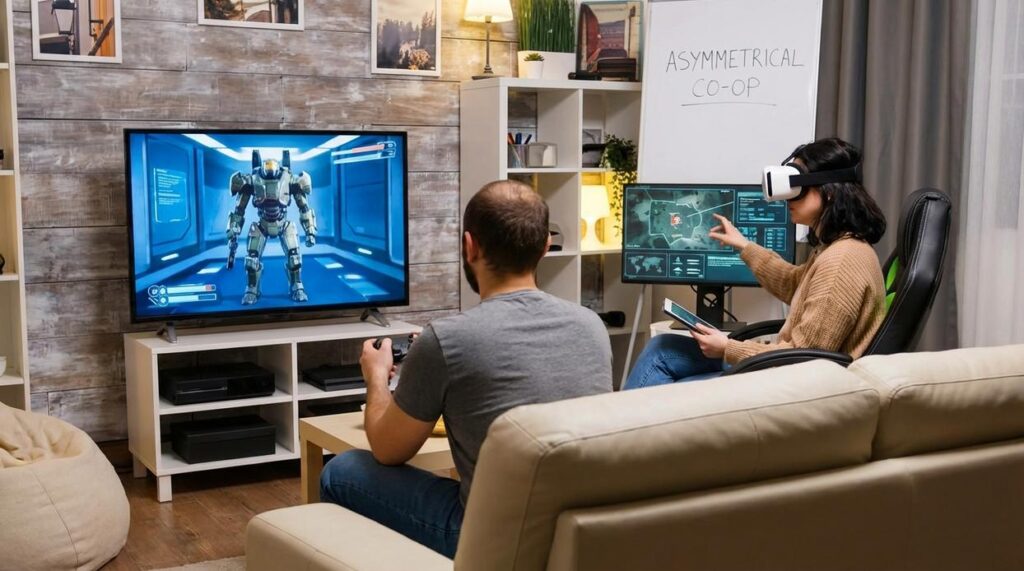
For years, the 100-player free-for-all defined multiplayer. But fatigue set in (there are only so many times you can drop from a bus). In gaming industry news 2026, the shift is clear: players want STRUCTURE, ROLES, and PURPOSE.
Trend 1 – Asymmetrical Gameplay
Asymmetrical gameplay—where teams have DIFFERENT abilities, objectives, and power levels—has surged. Think 4 survivors repairing generators while one overpowered hunter stalks them. This design creates interdependence, meaning each role fills a non-replaceable function. Unlike battle royale, where mechanical skill often dominates, asymmetrical systems reward communication and strategy.
Critics argue these games lack balance and replay value. Fair point—poor tuning can frustrate. But smart studios now use live data modeling and adaptive patches to maintain equilibrium (something competitors rarely break down technically). The result? Tension-driven matches that feel handcrafted rather than chaotic.
Trend 2 – The Game as a Platform
Non-combat social hubs are expanding fast. Virtual concerts, in-game film screenings, and interactive story events turn games into persistent digital spaces. This “platformization” transforms players into communities, not just competitors.
Skeptics say it’s fluff over gameplay. Yet engagement metrics show social events increase retention and cross-title loyalty—especially amid major game studio acquisitions and what they mean for players.
The deeper shift? Players crave belonging over leaderboards. And that’s a META evolution worth watching.
Hardware’s Next Leap: Optimizing Your Rig for Cloud-Native Gaming
Last month, I upgraded to a top-tier GPU—only to realize my cloud games still stuttered during peak hours. That’s when it hit me: in 2026, the real bottleneck isn’t raw graphics power. It’s network latency (the delay between your input and the server’s response). With high-fidelity cloud gaming rendering frames in remote data centers, your connection often matters more than your hardware.
Some players argue that a powerful local rig is still king. And sure, for offline or competitive LAN titles, horsepower counts. But for streamed AAA worlds? Latency spikes can ruin immersion faster than a low frame rate (and yes, it’s as frustrating as rubber-banding in early battle royale days).
So what actually helps?
1. Use Wired Ethernet
Wi-Fi adds interference and packet loss (tiny bits of lost data). Switching to Ethernet cut my input delay instantly. Pro tip: even a basic Cat6 cable can outperform premium Wi-Fi setups.
2. Configure Router QoS
Quality of Service (QoS) lets you prioritize gaming traffic over streaming or downloads. After enabling it, my evening sessions stopped freezing when someone launched Netflix.
3. Upgrade Your Monitor
A high-refresh-rate, low-response-time display reduces perceived input lag—even for streamed frames. It won’t fix bad internet, but it sharpens responsiveness.
As gaming industry news 2026 keeps highlighting, the future isn’t just in the cloud—it’s in how you connect to it.
Your Next Move: Thriving in the 2026 Gaming Landscape
The gaming industry news 2026 cycle has made one thing clear: smarter NPCs, blended genres, cooperative multiplayer, and network optimization are redefining how we play. You came here to understand what’s changing—and now you know the pillars shaping every major release this year.
But knowing is only half the battle. The real challenge is keeping up and choosing the right games and hardware in a landscape that evolves overnight.
By focusing on these core shifts, you can invest smarter, play better, and avoid wasting time on experiences that don’t deliver.
Now it’s your move. Pick the trend that excites you most, optimize your setup, and dive into your next session ready to dominate the future of gaming.